By Prof. Manjula Ranasinghe
Prof. Manjula Ranasinghe is a distinguished scientist affiliated with the World Scientific Congress, known for contributing three innovative research submissions in the latest session. These breakthroughs highlight his commitment to solving global challenges through science and technology.
In addition to his scientific achievements, Prof. Ranasinghe is a seasoned academic in Business Administration, with over 16 years of experience in teaching, research, and academic leadership. He is highly respected for his expertise in entrepreneurship, strategic management, and business innovation.
As a professor, he has mentored thousands of students and contributed to the development of advanced curricula in international universities. His work bridges the gap between science and business, fostering practical education aligned with global trends.
Abstract
The digital revolution has significantly transformed cost management practices across industries. Traditional cost control methods are being replaced by data-driven, technology-enabled approaches that offer real-time insights and strategic value. This paper explores the evolution of cost management techniques in the digital era, examining the transition from conventional methods to advanced digital tools. It discusses the implications of technologies such as big data analytics, artificial intelligence (AI), and cloud computing on cost management and highlights emerging trends and challenges. The study draws upon contemporary literature and case studies to provide a comprehensive understanding of this transformation.
Introduction
Cost management is a critical function in organizational strategy, influencing decision-making and competitiveness. Historically, cost management focused on budgeting, variance analysis, and cost control. However, the advent of digital technologies has disrupted traditional practices, enabling more dynamic and strategic approaches. This paper investigates how digitalization has reshaped cost management techniques, emphasizing the integration of advanced technologies and the shift towards strategic cost management.
Traditional Cost Management Techniques
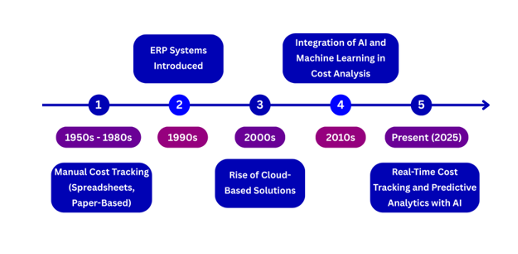
Traditional cost management techniques originated during the industrial age, when production processes were standardized, competition was limited, and business models were relatively simple. These methods primarily aimed to ensure internal financial control, with less emphasis on strategic adaptability or external responsiveness.
Standard costing was among the earliest techniques, involving the estimation of material, labor, and overhead costs to set cost benchmarks. Variance analysis helped managers monitor deviations from these standards, offering a tool for basic cost control. However, this method assumes stable production conditions and often fails in modern environments that demand customization and rapid change.
To address such shortcomings, Activity-Based Costing (ABC) emerged in the 1980s. ABC allocates overhead based on specific activities that drive costs, providing more accurate cost attribution, especially in multi-product environments. This method improved the visibility of cost drivers but was complex and data-intensive, limiting its widespread adoption without digital support.
Budgetary control is another cornerstone, involving the planning and comparison of expected versus actual financial outcomes. While effective in enforcing financial discipline, traditional budgets tend to be rigid and slow to adjust to dynamic business conditions, making them less effective in today’s fast-paced economy.
Despite their foundational value, these traditional techniques have notable limitations. They rely heavily on historical data, manual processing, and isolated departmental analysis. As a result, they often provide delayed and incomplete insights, making real-time strategic decision-making difficult. Moreover, they lack integration with modern data analytics and business intelligence systems.
In summary, while traditional cost management techniques laid the groundwork for organizational control, their limitations in flexibility, speed, and strategic alignment highlighted the need for evolution—paving the way for digital transformation in cost management.
Digital Transformation in Cost Management
The digital era has revolutionized the way organizations manage costs by integrating advanced technologies such as big data analytics, artificial intelligence (AI), cloud computing, and the Internet of Things (IoT) into financial practices. Unlike traditional cost management methods that relied on static data and retrospective analysis, modern digital tools allow real-time visibility and agile decision-making. This shift has transformed cost management from a control function into a strategic enabler of value creation and competitive advantage.
One of the key impacts of digital transformation is the automation of data collection and processing. ERP (Enterprise Resource Planning) systems now integrate finance with operations, supply chain, and customer service, allowing continuous monitoring of cost drivers across functions. These systems enable firms to gather and process large volumes of structured and unstructured data, including transactional data, market trends, customer behaviors, and operational metrics. This integrated, real-time data environment provides a comprehensive view of costs and profitability across the organization.
Strategic cost management in the digital era emphasizes dynamic performance metrics, scenario planning, and simulation modeling. Financial managers can now conduct “what-if” analyses instantly to understand the cost implications of different business decisions. According to Granlund and Taipaleenmäki (2005), digital transformation facilitates a broader, more strategic role for management accounting, empowering decision-makers to act quickly and accurately in volatile business environments.
Furthermore, digital tools enhance cost transparency and accountability by enabling cost-to-serve and customer profitability analyses. Companies can trace costs more precisely across products, segments, and service lines, supporting better pricing strategies and customer relationship management. This strategic application of cost information is a hallmark of modern digital cost management practices.
Big Data Analytics in Cost Management
Among the digital technologies reshaping cost management, Big Data Analytics plays a pivotal role. It refers to the capability to analyze vast and diverse datasets generated from various sources—including internal systems, social media, IoT devices, and external market databases—to extract actionable insights. In cost management, big data allows for more accurate forecasting, anomaly detection, and performance benchmarking.
Bhimani (2020) highlights that big data analytics transitions cost management from a backward-looking to a forward-looking discipline. For example, predictive models can identify potential cost overruns before they occur, allowing managers to take preventive action. Machine learning algorithms can analyze historical data patterns to forecast future spending, optimize resource allocation, and identify inefficiencies.
Real-time dashboards powered by analytics platforms such as Power BI or Tableau allow continuous tracking of key cost indicators. These dashboards can integrate operational and financial data, such as production rates, labor hours, and supply chain logistics, to provide a live picture of cost dynamics. This kind of visibility supports faster and more informed decisions, reducing reliance on month-end reporting and manual reconciliations.
Moreover, big data enhances driver-based costing by enabling a more nuanced understanding of what factors contribute to cost variation. Unlike traditional cost models that rely on broad assumptions, analytics can segment data by customer, region, channel, or time period to identify granular cost drivers. This supports precision in cost allocation and facilitates leaner operations.
The combination of big data with AI and machine learning also introduces the concept of smart costing—where systems learn from historical patterns and continuously refine cost predictions. These tools not only automate routine cost functions but also generate insights that improve long-term strategic planning and agility.
In conclusion, digital transformation and big data analytics have fundamentally altered the landscape of cost management. These tools enhance accuracy, timeliness, and strategic relevance, allowing organizations to operate more efficiently in a rapidly changing business environment. As digital capabilities continue to evolve, the role of cost management will expand further—moving beyond control to become a central pillar of organizational intelligence and competitiveness.
Artificial Intelligence and Machine Learning in Cost Management
Artificial Intelligence (AI) and Machine Learning (ML) have become transformative forces in the field of cost management. These technologies enable organizations to analyze vast and complex datasets with speed and precision, identifying patterns and anomalies that traditional methods may overlook. AI-driven systems can automatically classify costs, forecast expenditures, and recommend actions to minimize inefficiencies. Yang (2024) argues that integrating AI into cost management systems allows for faster, more informed decision-making by reducing the time spent on manual analysis.
A practical example of this can be seen in companies like Amazon and IBM, which employ AI-based predictive models to optimize logistics and operational expenses in real time. These models detect cost deviations, suggest optimal resource allocation, and even automate procurement decisions based on historical and market data. Such advancements not only enhance cost efficiency but also build adaptability into business processes—an essential trait in today’s volatile markets. AI also supports anomaly detection, alerting finance teams to irregularities such as fraud or duplicate payments, ensuring tighter financial control.
Cloud Computing and Cost Efficiency
Cloud computing has democratized access to advanced cost management tools by offering scalable, flexible, and cost-effective platforms. Rather than relying on traditional on-premise systems, businesses can now leverage cloud-based solutions to centralize financial data, access it in real-time from anywhere, and integrate seamlessly with other digital tools. Aguilar and Ittner (2019) emphasize that cloud computing enhances cost transparency and reduces infrastructure costs, especially for small and medium-sized enterprises (SMEs).
Modern cloud platforms like Oracle Cloud ERP and Microsoft Dynamics 365 offer built-in modules for budgeting, forecasting, and cost allocation, equipped with real-time analytics and AI-driven recommendations. A recent case is the global retailer Zara, which migrated much of its financial planning infrastructure to the cloud to enable faster, more coordinated cost controls across its supply chain during post-pandemic recovery. By doing so, the company could adjust rapidly to shifting customer demands while maintaining tight cost oversight. Cloud-based systems also improve collaboration, as stakeholders across departments can access and update cost data in real time, fostering cross-functional alignment in budgeting and strategic planning.
Strategic Cost Management in the Digital Era
Traditional cost control approaches often focused solely on minimizing expenses. However, in the digital era, the emphasis has shifted to Strategic Cost Management (SCM)—a more holistic approach that aligns cost structures with business objectives and market demands. SCM integrates tools such as value chain analysis, customer profitability analysis, and competitive benchmarking to identify cost drivers that impact value creation.
Digital technologies enhance SCM by enabling granular insights and supporting proactive decision-making. Bhimani (2015) asserts that digital platforms allow organizations to better understand cost behavior across the value chain, enabling strategic decisions such as product redesign, outsourcing, or market segmentation. For instance, Tesla uses data-driven cost modeling to align production costs with innovation goals, helping it maintain profitability while scaling operations globally.
In sum, the integration of AI, cloud computing, and strategic frameworks signifies a profound evolution in cost management. These tools not only increase efficiency and accuracy but also embed cost intelligence into broader business strategy, enabling organizations to thrive in a fast-paced, competitive digital economy.
Emerging Trends and Challenges
IoT devices collect real-time data on equipment usage, energy consumption, and other operational metrics, contributing to more accurate cost tracking and management. This integration allows for preventive maintenance and resource optimization. Moll and Yigitbasioglu (2019) assert that IoT enhances the granularity of cost data, enabling more precise cost management.
Challenges in Digital Cost Management: Cybersecurity and Skill Gaps
As organizations increasingly rely on digital systems for cost management, new vulnerabilities have emerged—most notably in the areas of cybersecurity and workforce capabilities. While digital transformation brings significant advantages such as automation, real-time insights, and predictive analysis, it also exposes sensitive financial data to greater risks and reveals skill gaps that must be addressed for successful implementation.
Cybersecurity concerns are among the most critical challenges in digital cost management. The integration of cloud-based platforms, artificial intelligence, and big data analytics means that vast amounts of financial and operational information are stored, processed, and transmitted online. This interconnectedness increases the risk of cyberattacks, data breaches, and unauthorized access. A single vulnerability can expose confidential cost structures, supplier agreements, or strategic financial plans, leading to severe financial and reputational damage. In recent years, high-profile breaches in multinational corporations such as Equifax and Target have underscored the financial consequences of inadequate cybersecurity infrastructure. To mitigate these risks, organizations must implement robust security protocols, including multi-factor authentication, encryption, firewalls, and continuous monitoring. Additionally, compliance with international data protection regulations such as GDPR or ISO/IEC 27001 has become essential for maintaining stakeholder trust.
Skill gaps represent another significant barrier to the effective use of digital cost management tools. The shift from manual or spreadsheet-based methods to advanced platforms requires a workforce proficient in data analytics, machine learning, and financial technologies. Many organizations, particularly in traditional industries, struggle to find or develop talent with the necessary expertise. Without skilled professionals, digital systems may be underutilized or misinterpreted, resulting in flawed decision-making and poor return on technology investments. Companies must prioritize training and upskilling programs to bridge these gaps. Partnerships with academic institutions, internal workshops, and professional certifications can help build a future-ready finance team capable of leveraging digital tools effectively.
In summary, while digital cost management offers transformative potential, addressing cybersecurity and skill development is essential to fully realize its benefits and safeguard organizational value.
Case Studies
FinTek Manufacturing Ltd., a mid-sized electronics company in Germany, adopted digital cost management tools in 2021 to improve budgeting, real-time monitoring, and cost analysis. They implemented a cloud-based ERP system integrated with AI features to enhance financial decision-making.
Cybersecurity Concern:
In 2022, FinTek faced a ransomware attack that targeted their financial data through a vulnerability in their cloud service provider. The breach led to encrypted cost data, operations delays, and financial losses of over €1.5 million. Sensitive information, including supplier costs, was exposed, damaging the company’s reputation.
Response:
The company upgraded to a more secure cloud platform with international cybersecurity standards, added two-factor authentication, and launched employee training programs to prevent future breaches. This highlighted the critical need for strong cybersecurity in digital cost systems.
Skill Gap Challenge:
FinTek also faced a shortage of skilled staff who could utilize AI-driven cost tools effectively. The finance team struggled with features like cost pattern recognition and forecasting due to limited data analytics knowledge.
Response:
To bridge this gap, FinTek partnered with a local university to provide staff with training in AI and data analytics. Within months, their cost analysis improved, and decision-making became more agile.
Conclusion
The digital era has revolutionized cost management, transitioning it from traditional, reactive methods to proactive, strategic practices enabled by advanced technologies. Big data analytics, AI, cloud computing, and IoT have enhanced the accuracy, efficiency, and strategic value of cost management. However, organizations must address challenges such as cybersecurity risks and skill shortages to fully leverage these technologies. Embracing digital transformation in cost management is imperative for organizations seeking to maintain competitiveness and achieve sustainable growth.
References
- Bhimani, A. (2015). Exploring big data’s strategic consequences. Journal of Information Technology, 30(1), 66–69.
- Bhimani, A. (2020). Accounting Disrupted: How Digitalization is Changing Finance. Wiley.
- Drury, C. (2018). Management and Cost Accounting (10th ed.). Cengage Learning.
- Horngren, C. T., Datar, S. M., & Rajan, M. (2015). Cost Accounting: A Managerial Emphasis (15th ed.). Pearson.
- Kaplan, R. S., & Atkinson, A. A. (1998). Advanced Management Accounting (3rd ed.). Prentice Hall.
- Moll, J., & Yigitbasioglu, O. (2019). The role of internet-related technologies in shaping the work of accountants: New directions for accounting research. The British Accounting Review, 51(6), 100833. https://doi.org/10.1016/j.bar.2019.04.002
- Romney, M. B., & Steinbart, P. J. (2021). Accounting Information Systems (15th ed.). Pearson.
- Yang, F. (2024). Research on the Optimization Path of Strategic Cost Management under the Background of the Digital Economy. Journal of Applied Economics and Policy Studies, 11, 62–66. https://doi.org/10.54254/2977-5701/11/2024109
- Zaman, M., & Sulaiman, M. (2021). Digital Transformation in Accounting: Opportunities and Challenges. International Journal of Accounting and Financial Reporting, 11(1), 50–65. https://doi.org/10.5296/ijafr.v11i1.18061
- Cokins, G. (2017). Performance Management: Integrating Strategy Execution, Methodologies, Risk, and Analytics. Wiley.
- Quattrone, P. (2016). Management accounting goes digital: Will the move make it wiser? Accounting, Auditing & Accountability Journal, 29(4), 644–667. https://doi.org/10.1108/AAAJ-02-2016-2429