By Prof. Manjula Ranasinghe, PhD
Introduction
In the contemporary business landscape, organizations grapple with the dual challenge of maintaining competitiveness while ensuring operational efficiency. Amidst fluctuating market dynamics, globalization, technological disruptions, and escalating operational costs, the adoption of Lean Management principles emerges as a strategic imperative. Businesses today are not only expected to deliver quality and innovation but also to do so swiftly and cost-effectively. The growing demand for customer-centric solutions and streamlined operations necessitates an agile and resilient organizational model, and this is where Lean Management offers profound advantages.
Originating from the Toyota Production System in the mid-20th century, Lean Management has evolved from a set of manufacturing practices into a comprehensive managerial philosophy. It emphasizes the elimination of non-value-added activities (commonly referred to as “waste”), continuous improvement (Kaizen), and maximizing value for end-users. Over the decades, companies like Toyota, Boeing, Amazon, and General Electric have adopted Lean thinking to significantly improve productivity, enhance customer satisfaction, and reduce costs.
As organizations strive to reinvent their business models amidst crises like the COVID-19 pandemic and supply chain disruptions, Lean principles offer a proven framework for sustainable efficiency. Lean has moved beyond the assembly lines into knowledge work, healthcare, education, software development, public administration, and finance. Its universal applicability makes it a cornerstone of modern operational excellence initiatives. Integrating Lean principles into various organizational structures—from flat startups to complex matrix organizations—can result in substantial cost reductions, improved resource allocation, faster time-to-market, and a more engaged workforce.
The strategic integration of Lean not only addresses inefficiencies but also cultivates a culture of accountability, problem-solving, and innovation. As research from McKinsey (2023) and Harvard Business Review (2022) highlights, companies that embed Lean practices in their core operations tend to outperform competitors in key performance indicators, including cost-efficiency, customer loyalty, and employee productivity. This article explores how Lean Management can be effectively integrated into different organizational structures to foster sustainable cost efficiency and long-term value creation.
Understanding Lean Management
Lean Management is a systematic and data-driven approach aimed at maximizing customer value by minimizing waste and optimizing process flows. Coined and refined through decades of practice in the Japanese automotive industry—especially at Toyota—Lean has become a global methodology synonymous with operational excellence and continuous improvement.
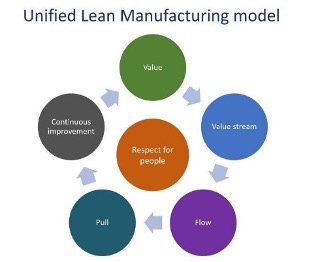

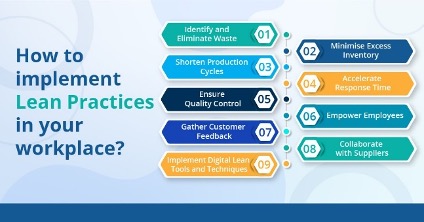
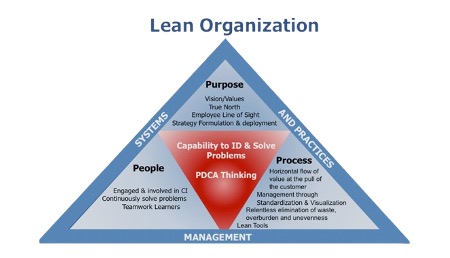
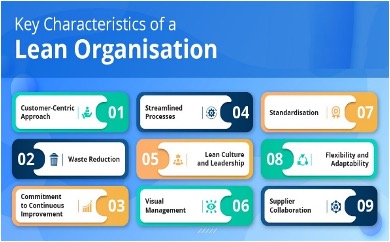
At the heart of Lean lies five foundational principles, initially formalized by James P. Womack and Daniel T. Jones in their seminal book “Lean Thinking” (1996):
- Specify Value – Understand what constitutes value from the customer’s viewpoint. This means distinguishing between what the customer is willing to pay for and what constitutes waste.
- Map the Value Stream – Identify all the steps in the process chain, from input to delivery, and classify each as value-adding or non-value-adding. This mapping highlights areas for improvement.
- Create Flow – Eliminate interruptions and inefficiencies in the process to ensure that work proceeds smoothly from one stage to the next.
- Establish Pull – Products and services should be produced only as demanded by the customer, rather than based on forecasts or batch processes.
- Pursue Perfection – Encourage a culture of continuous improvement (Kaizen), where teams consistently seek ways to enhance processes and reduce waste.
Lean identifies seven major types of waste—overproduction, waiting, transport, extra processing, inventory, motion, and defects—often remembered using the acronym TIMWOOD. Recently, an eighth waste, underutilized talent, has been added to highlight the importance of leveraging employee skills and creativity.
Importantly, Lean is not a one-size-fits-all methodology. It is adaptable and scalable, capable of being customized for different types of organizations and industries. For instance:
- In healthcare, Lean is used to reduce patient waiting times, streamline diagnostics, and improve the quality of care (Graban, 2020).
- In financial services, it helps eliminate redundant paperwork, automate routine tasks, and improve customer onboarding (Young & Ballard, 2021).
- In software development, Lean principles underpin Agile and DevOps practices, enabling faster delivery of software products with fewer bugs and rework (Poppendieck & Poppendieck, 2003).
Furthermore, Lean intersects with other methodologies such as Six Sigma, Total Quality Management (TQM), and Agile. This integration provides a comprehensive toolkit for organizations seeking to optimize performance while maintaining high standards of quality and innovation.
From an organizational behavior perspective, Lean encourages decentralization of decision-making and empowerment of frontline employees. This cultural shift promotes ownership, cross-functional collaboration, and innovation—all of which are essential for cost-efficiency and sustained competitive advantage.
With the rise of digital transformation, Lean has entered a new phase—Lean Digital—which leverages automation, AI, and real-time analytics to enhance the traditional Lean toolkit. For example, Robotic Process Automation (RPA) is now used to automate repetitive tasks in HR and finance, while data analytics helps identify bottlenecks in service delivery (Deloitte, 2023).
Thus, Lean Management is not merely a cost-cutting tool but a holistic management philosophy that integrates operational excellence, employee engagement, customer satisfaction, and strategic adaptability.
Organizational Structures and Lean Integration
Organizational structure significantly influences the efficacy of Lean implementation. The structure determines how communication flows, how decisions are made, and how responsibilities are distributed—each of which directly impacts the success of Lean integration.
Traditional hierarchical structures, characterized by multiple management layers and rigid reporting lines, often impede swift decision-making and adaptability. These bureaucratic systems tend to create information silos, reduce the visibility of front-line operations, and slow down response times to customer feedback and process inefficiencies. In such environments, Lean initiatives may face resistance due to entrenched power dynamics and reluctance to change established routines.
In contrast, flat organizational structures reduce the number of management layers and decentralize authority, promoting better communication, faster decision-making, and higher accountability. Lean thrives in flat structures where employees are empowered to take initiative, experiment with solutions, and make decisions at the point of execution. Companies like Tesla and Spotify adopt flatter or team-based models to foster innovation and responsiveness, aligning well with Lean’s emphasis on speed and customer-centricity.
A more adaptive alternative is the matrix organizational structure, where employees may report to more than one manager—typically both a functional and a project manager. This model encourages cross-functional collaboration and resource sharing, essential traits for Lean transformation. In a Lean environment, matrix structures allow teams to quickly reconfigure based on project demands or market shifts. For example, Procter & Gamble uses a matrix structure to balance product innovation with operational excellence, integrating Lean across R&D, marketing, and supply chain functions.
Additionally, networked and holacratic structures—which emphasize decentralized decision-making and self-managed teams—are emerging as effective models for Lean integration in the digital era. Companies like Zappos and Haier use decentralized or team-of-teams frameworks to empower frontline employees, enabling rapid experimentation and continuous feedback loops.
However, integrating Lean into any structure requires a tailored approach. In hierarchical systems, the transformation must begin with leadership buy-in and cultural shifts. In matrix or agile setups, emphasis should be on process coherence, role clarity, and standardized improvement frameworks to avoid chaos.
According to a 2022 study in the Journal of Operations Management, organizations that align their structure with Lean principles—especially through cross-functional teams and decentralized problem-solving—achieve a 25–35% improvement in cost efficiency and time-to-market compared to firms that attempt Lean in isolation from their structural setup.
Ultimately, the success of Lean integration depends not only on the principles themselves but also on the organizational infrastructure that supports or inhibits their application.
Strategies for Integrating Lean Principles
To maximize the effectiveness of Lean Management across diverse organizational structures, several strategic enablers must be embedded in the operational and cultural fabric of the organization. The following strategies represent best practices validated by both industry experience and academic research:
1. Leadership Commitment
Lean transformation begins at the top. Senior leadership must go beyond verbal support and actively champion Lean as a strategic priority. This involves setting clear goals, allocating resources, and modeling Lean behaviors—such as data-driven decision-making, daily Gemba walks (on-site observation), and respect for frontline insights.
Organizations like Boeing and Intel have embedded Lean into their leadership development programs, ensuring that new managers are equipped to lead continuous improvement efforts. As emphasized in “Leading the Lean Enterprise Transformation” by George Koenigsaecker (2012), sustainable Lean change requires leaders to act as coaches and catalysts, rather than command-and-control executives.
2. Employee Engagement
A cornerstone of Lean is respect for people. Employees at all levels must be empowered to identify inefficiencies, contribute ideas, and take ownership of process improvements. Empowerment goes hand-in-hand with skill development. Training initiatives such as Lean Six Sigma certification, Kaizen workshops, and visual management practices (e.g., Andon systems) foster employee capability and confidence.
Case studies in Harvard Business Review (2022) show that firms with high employee engagement in Lean programs are 3.5 times more likely to sustain gains and embed a culture of continuous improvement. Tools such as suggestion systems and daily team huddles promote ongoing communication and recognition of employee contributions.
3. Process Mapping
Value Stream Mapping (VSM) and SIPOC (Suppliers-Inputs-Process-Outputs-Customers) diagrams are powerful tools for visualizing processes end-to-end. These techniques help identify bottlenecks, redundancies, and non-value-added activities.
In industries like healthcare and logistics, process mapping has led to transformative results. For example, Cleveland Clinic used VSM to reduce patient discharge time by 30%, significantly improving bed turnover and patient satisfaction. Process mapping also ensures transparency and creates a shared understanding among cross-functional teams—a critical success factor in matrix structures.
4. Standardization
Standard work is the foundation of Lean stability and scalability. By establishing clear procedures, guidelines, and performance norms, organizations can minimize variability, ensure compliance, and create a baseline for continuous improvement. Standardization does not imply rigidity; rather, it enables faster problem identification when deviations occur.
Companies like Toyota and Amazon use standardized work instructions not only for physical tasks but also for knowledge work, ensuring consistency in customer service, inventory control, and software deployment. These standards are continuously refined through employee feedback and iterative testing.
5. Performance Metrics
Metrics drive behavior. To measure Lean progress effectively, organizations must establish Key Performance Indicators (KPIs) aligned with Lean objectives. These include:
- Lead time
- First-pass yield
- Overall Equipment Effectiveness (OEE)
- Customer satisfaction (Net Promoter Score)
- Employee involvement (Kaizen suggestions implemented)
- Cost per unit or service
Dashboards and digital management boards provide real-time data visibility, facilitating daily management routines such as the Daily Management System (DMS) and Plan-Do-Check-Act (PDCA) cycles. Advanced analytics and AI are now being used to predict performance trends and prescribe interventions—a development dubbed “Lean 4.0.”
A 2023 McKinsey report highlights that companies leveraging digital KPIs in Lean implementations see a 40% faster time-to-impact compared to those using traditional reporting tools.
Case Studies
- Toyota Motor Corporation: As the progenitor of Lean Management, Toyota exemplifies the successful integration of Lean principles. Through practices like Just-In-Time production and continuous improvement (Kaizen), Toyota has achieved remarkable efficiency and cost savings.
- Virginia Mason Medical Center: This healthcare institution adopted Lean methodologies to enhance patient care and reduce costs. By streamlining processes and eliminating non-value-added activities, the center improved patient outcomes and operational efficiency.
- Intel Corporation: Intel implemented Lean principles to optimize its manufacturing processes. The company focused on reducing cycle times and inventory levels, resulting in significant cost reductions and improved product delivery timelines.
Challenges in Lean Integration
While the benefits of Lean integration are substantial, organizations may encounter challenges, including:
- Cultural Resistance: Shifting organizational culture to embrace Lean principles can be met with resistance. Overcoming entrenched behaviors and mindsets requires effective change management strategies.
- Resource Constraints: Implementing Lean initiatives demands time, financial investment, and human resources. Organizations must balance these requirements with ongoing operational demands.
- Sustaining Momentum: Maintaining the gains achieved through Lean initiatives necessitates continuous monitoring, reinforcement, and adaptation to evolving business environments.
Conclusion
Integrating Lean Management principles into organizational structures offers a pathway to significant cost reductions and enhanced operational efficiency. By fostering a culture of continuous improvement, empowering employees, and aligning processes with customer value, organizations can navigate the complexities of the modern business environment effectively. While challenges exist, the strategic implementation of Lean principles can yield sustainable competitive advantages and drive long-term success.
References
- Womack, J.P., & Jones, D.T. (1996). Lean Thinking: Banish Waste and Create Wealth in Your Corporation. Simon & Schuster.
- Liker, J.K. (2004). The Toyota Way: 14 Management Principles from the World’s Greatest Manufacturer. McGraw-Hill.
- Ohno, T. (1988). Toyota Production System: Beyond Large-Scale Production. Productivity Press.
- Rother, M., & Shook, J. (2003). Learning to See: Value Stream Mapping to Add Value and Eliminate MUDA. Lean Enterprise Institute.
- George, M.L. (2002). Lean Six Sigma: Combining Six Sigma Quality with Lean Production Speed. McGraw-Hill.
- Graban, M. (2016). Lean Hospitals: Improving Quality, Patient Safety, and Employee Engagement. CRC Press.
- Dennis, P. (2015). Lean Production Simplified: A Plain-Language Guide to the World’s Most Powerful Production System. Productivity Press.
- Womack, J.P., & Jones, D.T. (2003). Seeing the Whole: Mapping the Extended Value Stream. Lean Enterprise Institute.
- Spear, S., & Bowen, H.K. (1999). Decoding the DNA of the Toyota Production System. Harvard Business Review, 77(5), 96-106.
- Shah, R., & Ward, P.T. (2007). Defining and developing measures of lean production. Journal of Operations Management, 25(4), 785-805.
- Netland, T.H. (2016). Critical success factors for implementing lean production: The effect of contingencies. International Journal of Production Research, 54(8), 2433-2448.
- Bhasin, S. (2012). Prominent obstacles to lean. International Journal of Productivity and Performance Management, 61(4), 403-425.
- Hines, P., Holweg, M., & Rich, N. (2004). Learning to evolve: A review of contemporary lean thinking. International Journal of Operations & Production Management, 24(10), 994-1011.
- Emiliani, M.L. (2006). Origins of lean management in America: The role of Connecticut businesses. Journal of Management History, 12(2), 167-184.