

Author: Oleg Nikolayevich Murashov, Instructor (PhD Reading)
Email: handel2010@mail.ru
Moscow
Abstract
The article presents a description of a new (alternative) technology for teaching reading in English to preschool and younger school-aged students. The relevance of the topic is driven by numerous difficulties faced by Russian-speaking students in mastering the letter-sound world of the English language and the need to find alternatives to traditional pedagogical methods (studying the English alphabet and rules), which are no longer effective today.
The goal of this work is to present a new reading technology and the tools that have already stood the test of time. Their emergence is the result of many years of creative experimentation (over 15 years), involving about a thousand Russian-speaking children aged 6 to 9 years and dozens of instructors who have applied new reading tools in their daily practice.
This scientific article is distinguished by a comprehensive approach: reading difficulties are identified and analyzed; the main groups of children with various reading/perception types are defined, from which the further route of work with each group is constructed; existing alternative reading technologies are described; new tools are thoroughly described, including the history of their emergence; the reading teaching process becomes a mini-course filled with modern methodological materials.
The results obtained during the experiment allow for the assertion that not only the speed of mastering reading in English increases, but also the quality: within just 3-4 months, over 50% of students reach an intermediate level from “zero,” surpassing the standard program by 3-4 years. Moreover, this improvement is evident not only in reading but also in general grammar. Even those who did not achieve such high results during the experiments later do not face significant difficulties in mastering the standard school English program.
Keywords: educational process, teaching reading in English, alternative reading instruction, English alphabet, stress in English, Twinkl Phonics.
Introduction
Teaching reading to preschool and younger school-aged children even in their native language presents significant challenges. What can be said about the difficulties faced when teaching reading in English to foreigners? (Here, “foreigners” primarily refers to all students whose native languages do not use the Latin script).
I would also like to note that the analysis is based not only on scientific literature but, to a greater extent, on over 40 years of experience in teaching students from Russia aged 4-5 years and older, both in groups and individually.
Before moving on to the main section of the article, it is essential to accurately determine which aspect of “reading” will be examined in detail in this article. There are three of its most important aspects are highlighted:
- Reading as understanding meanings. This is the most complex and simultaneously fruitful process, as it requires the utmost spirit and concentration of personal experience, yet it provides the reader with an indescribable, incomparable satisfaction! It is this level that allows one to perceive the text as something independent rather than as a mere collection of symbols/letters or sounds.
- Reading as educational material that enables the reader/student to identify certain gaps in their grasp of grammar (and more) and thereby continue the process of improvement. In this sense, reading serves as a unique tool, remarkably accessible and simple for students of all ages and varying financial means and social standings.
- Reading as a process of transforming symbols (letters, hieroglyphs, runic alphabet signs, Devanagari, etc.) into corresponding voice streams that, blending and complementing each other, create what we call “speech.” Of course, this is not yet the reading mentioned in the first point, but it serves as a foundation for deeper immersion into the unknown depths of language.
In this work, all attention is focused specifically on the third point, which, despite its simplicity (some might even call it “primitiveness”), requires incredible concentration and many hours of diligent practice, as it is also related to pronunciation. This is especially true for the English language, which has an extremely complex and convoluted system of rules and exceptions that intimidates every beginner.
Difficulties in reading English
Why is it so important to point out the main difficulties in reading in English? Only by clearly identifying them can we then discuss solutions to the problem. The format of this article does not allow for enumerating all these complexities; therefore, we will focus on some that we consider the most significant.
Firstly, in most cases, beginners are initially introduced to the alphabetic sounds of English letters. However, this sound often changes in words, and many letters become “silent,” meaning they are not pronounced. According to the theory of audio-psychophonology by the famous French scientist A. Tomatis, “the voice contains (reproduces) only what the ear can hear.“ Thus, learning the English alphabet only complicates the task and, in some cases, becomes an insurmountable obstacle for students. Accustomed primarily to the alphabetic version, the student subsequently cannot correctly pronounce a word/phrase.
For example, in the word cat, the first letter C sounds like “si” according to the alphabet, the second letter A sounds like “ei,” and the third letter T sounds like “ti.” If someone suddenly pronounces/reads the word according to the alphabetic version, they will get garbled nonsense: “sieiti” (instead of “kæt”).
Secondly, the same vowel letter in English can have several sound variations in words. For instance, the letter A in the word take sounds like “ei,” while in the word was, it sounds like something in between “o” and “a,” in man it is “æ,” in park it is a long “a:,” and in war it is a long “ɔː”. This situation, or even more convoluted scenarios, applies to most consonant letters. Interestingly, many teachers in Russian schools—both public and private—attempt to translate English sounds using Russian letters, which, in our opinion, should only be used in extreme cases and cannot be a primary tool.
Thirdly, there are a considerable number of words in English whose pronunciation cannot be explained in terms of reading rules and does not conform to any logic. This includes unreadable letters (so-called “silent” letters), very strange combinations, and exceptions that defy classification. Try to read the following words yourself:
- choir – /ˈkwaiə/
- queue – / kjuː/
- doubt – / daʊt/
- neighbour – / ˈneibə(r)/
- sough – /saʊ/
- vehicle – /ˈviːəkl/, etc.
Thus, it can be concluded that familiarization with the alphabet at an early age, in reality, only complicates the reading process. Many educators and philologists, including those in Russia, hold this viewpoint. However, little changes in practice. However, the most significant difficulty in reading in English lies not even in recognizing letters and pronouncing them correctly, but in adhering to certain rules/patterns that emerge when articulating two or more words. These can be word groups and phrases/sentences (utterances). Any student, even at a very young age, can effortlessly pronounce a single English word, looking at the still somewhat unfamiliar letters. For instance, children joyfully repeat after their parents the names of objects, attributes, actions, and even some phrases: cat, dog, red, sleep, please, good morning, good night, etc. But when that same word appears in combination with other words, the student suddenly experiences immense difficulty. It is not that they “cannot see” the letter or word they previously pronounced confidently. The reason lies elsewhere. More precisely – there are multiple reasons. Let’s try to understand why this happens.
The most important/popular words in English have a very short duration. Their average length is about 1.3 syllables. In other words, about half of the commonly used English words (and it is these that form everyday communication) have one or two syllables. These syllables then connect, merge, and create new, peculiar, and unfamiliar sounds/sound combinations! At this point, one must transition from the task of “correctly reading/pronouncing a word” to mastering a comprehensive program with many unknowns:
- where to place the stress in this “muddle”?
- where to take a breath?
- which word to pronounce with an ascending/descending tone?
- how to transition correctly from one word to another?
These “questions” are almost never considered part of the educational process in either English textbooks or school lessons. So, the student is left alone with the most challenging section and tries diligently to “read,” relying on the alphabetic sounds of English letters and their experience of reading in their native language, which leads to the emergence of unnecessary “neologisms.”
An incredible difficulty, which will only be briefly mentioned in this article, is stress in English words and the related “moments” (syllabification, the ability to see endings, suffixes, prefixes, etc.). Not to mention the additional stress in the same English word, which is completely unacceptable, for example, in Russian. The fact is that here we are already stepping beyond the “purely grammatical” understanding and must accept this vast amount of information as a given.
In this regard, the thoughts of Wilhelm von Humboldt about stress in English are very interesting: “… in the same word, there can, of course, be secondary stresses triggered either by its rhythmic structure or the necessity to highlight nuances of meaning. In no other language is this as evident as in English. … The combination of this feature with the laws of euphony gives rise to the structure of the English word, which is truly astonishing regarding stress and pronunciation.”
To summarize this brief section, one can conclude that teaching reading in English using traditional methods (alphabet + memorization of numerous rules) is often perceived by Russian-speaking students as mockery, an act of violence, a refined torture. When adding to this the awkward transitions from one sound to another, numerous contractions, and unfamiliar sounds, the picture becomes even darker. The instructor can try very hard and even feel pleased with their effective presentation of the material. However, as practice shows, most of the class pushes this material away like an annoying fly: there is too much information to memorize. Moreover, the standard way of delivering the material (most often a simple retelling of textbook content) does not contribute to sparking interest. The result is predictable: even students in the middle and senior grades cannot read in English.
History of the emergence of the “Look-Read” technology and a brief description of Its main tools
The acquaintance with the book “Language” by the wonderful American linguist Leonard Bloomfield in 2002 can be considered the beginning of a major effort to reorganize the entire system of teaching reading in English. Here are just some quotes from his book that prompted a complete reevaluation of the educational process:
- “It is incorrect to say that changing our orthography (the English orthography) would mean ‘changing our language’: our language will remain the same regardless of how we write.”
- “… it is necessary to teach children to read phonetic transcription, and to approach traditional writing only after essential reading skills are mostly secured.”
- “… one should start with spellings that contain only one phonemic value for each letter, that is, with rows in a certain system (silent gh: fight, light, might, night, right, sight, tight; pronounced before l as ɔ: all, ball, call, fall, gall, hall, tall, wall, halt, malt, salt, bald, false).”
- “It may be useful to highlight (for example, with different colors) silent letters and letters with irregular phonemic values.”
Thus, as early as 2003, we began applying the reading system that would later be called “phonics” (Twinkl Phonics). The children greatly enjoyed playing “rhyme games”: this is how we referred to rows/chains of words with a similar set of letters in our groups. For example: day – pay – way – lay – say – may – ray…
The next step was to complicate the chains, allowing young students to see certain patterns:
- like – lime – line – mine – fine – file – mile – mine – fine…
- Or a more complex variant: mind – sign – night – knight – lie…
The first word in such a chain should generally be well-known to the student. Therefore, they will read all the other words quite confidently. For example:
- night /nait/ – might – light – sight – bright – alright – delight
Here is the same chain transformed by the students into a fairy-tale game format:
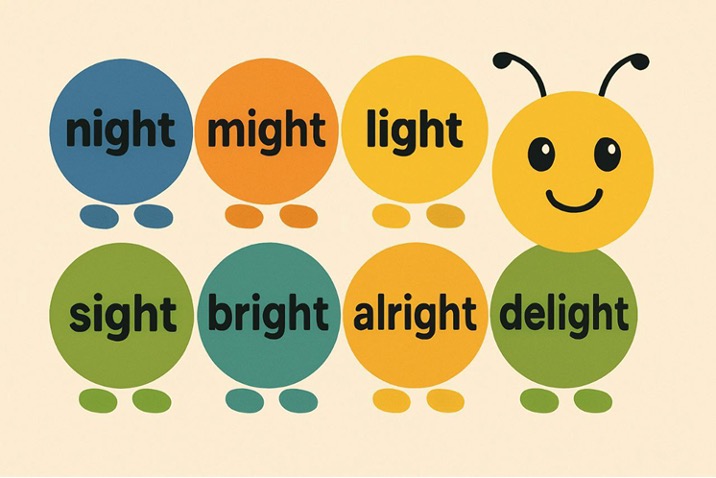
Many parents worry that they will not be able to create such chains on their own. In reality, it could even be a part of a word, but with the same set of letters. The key is for the child to realize that identical combinations of letters produce the same sounds.
It is best to start with short chains of 4–5 words. Then, their number can be increased. Constantly practicing these chains gives students confidence and courage without the need to memorize reading rules.
One can talk for a long time about how the theory of chains developed in our groups; however, this is not the aim of the article. Although it should be noted that the rapidly spreading method of reading through “chains” (phonics) is a significant step forward compared to traditional school methods. Yet, even this progressive approach has not brought enjoyment and complete satisfaction. The most serious drawback of this system is that even responsible students find themselves struggling when a second (additional) task appears.
For instance, it is quite simple to read the chain: night (nait) – fight – might – light – sight because only the first letter/sound changes in each word. But if the task is slightly complicated, confidence disappears: night /nait/ – wright /rait/ – knight /nait/ – sigh /sai/. In the second and third words, the first letters are unreadable: rait – nait, and in the last word, there is no familiar letter t, resulting in /sai/
Even more difficulties arise when a student tries to read a chain like: love – glove – comfort – none – onion, where the first vowel letter (o) produces the sound -a. Constant reminders to the reader that all words in the chain should sound the same do not help; this difficulty resides at a subconscious level. Agree: it is almost impossible to convince oneself that a sheet of paper painted red is, let’s say, green. Then, using the same tube of red paint, one attempts to make a new stroke on another sheet and persuade oneself and others that this is, for instance, … blue.
In words like bread – ready – head – health – heaven – meant – measure – lead – sweat, the combination of letters –ea produces a sound similar to our Russian letter – э.
In words like dream – each – eagle – easy – east – eat – feast – feat, the same combination of letters gives a long sound – i:.
Attempts to explain this phenomenon yield no good results, as the instructor inadvertently intrudes into the student’s personal space, which is governed by all their accumulated experiences and the insights and understandings of reality gifted to them at birth. Even when dealing with a single student rather than a group, this conflict (often latent or hidden) easily transforms into opposition, and then into rejection and refusal of any explanation.
Ultimately, a decision was made: to find a way to teach the child to read in English without explaining the rules, as their number is vast; simply teaching and memorizing reading rules in English is an extraordinarily complex task. Moreover, engaging young children with such experiences is simply impossible.
Over the next 15 years, the teachers at our school conducted a long-term experiment aimed at identifying the most effective tools to help Russian-speaking children aged 6–8 years start reading in English quickly and confidently without using the standard approach of studying the alphabet and reading rules. During this time, more than 1,000 children participated in the experiment. Each mini-group of 4-5 students was given a clear task: to reach an intermediate level of reading in English within 3 months (during the summer holidays), starting from zero.
As a result of this extensive and targeted work, an independent course titled “Look-Read” was developed. The name itself carries meaning: you look at the English letters/words and pronounce their sound equivalent very close to the original. Additionally, several comprehensive articles for teachers were written and published, and finally, a rather unique textbook called “Phonetic Fairy Tales” was prepared and published. However, besides fairy tales, the textbook includes substantial methodological material for parents and educators, featuring a detailed explanation of the new reading technology using the analysis of a song by The Beatles(“We can work it out”). Since it is impossible to explain to young children how the letter-sound world of English is structured using traditional methods and rules, “metaphysical” tools were employed (in our case, educational fairy tales) along with special sound exercises (chains of words) described above.
By the way, we continue to use fairy tale techniques and invented worlds even now. It turns out that they work well for all ages. For example, all the letters are anthropomorphized, so their whimsical combinations are now perceived by students as relationships between people (relatives, acquaintances, etc.) in various understandable situations. For instance, all vowel letters are girls (they love to vocalize), and boys readily agree with them—they are consonants. This simple tactic allows for the creation of incredible, yet quite plausible “explanations.” Moreover, students can come up with them themselves, as we transition from the narrow plane belonging to linguists and philologists to a narrative, human world.
Here, for example, is one of the children’s stories dedicated to reading the letter combination “mb” at the end of English words. Misha is a boy who plays soccer; he is strong and loves to brawl. Borya is a musician; he is weaker and does not like to get into fights. Of course, Borya fears Misha, so he prefers to remain silent. And so on… These “tales” yield real results: practically all students start to correctly read words like climb /klaim/, comb /keum/, lamb /læm/, and no one perceives them as exceptions or “sight words” anymore.
However, all these fairy tale stories, despite their appeal and great potential, also have limits. The creation of such “fantastical stories” is not an end in itself, as it may seem to students. The imagination of my students and mine constitutes a vast material, a whole world that suddenly begins to exist “on its own,” gradually crossing the boundary in the consciousness of children and adults between a teaching tool and “just a tale.” However, we have a task: to quickly and confidently transform symbols into adequate sounds. Therefore, the tools used to accomplish this task must also be clear and precise.
The key to success in mastering the described technology lies in the constant listening to a model. In our case, this could be a particular popular English song. Interestingly, it works best with large headphones.
Throughout the course (approximately 100 days), students managed to read and memorize 4–5 songs. This amount is quite enough to get accustomed to the most popular letter combinations encountered in the English language. In the first two years, we began with short texts, poems, and counting rhymes. However, it turned out that a song is the most successful entry point into the world of reading since, in addition to rhymes – a very powerful tool! – the song contains rhythm, vocalization, and work with breathing. Moreover, a song can be sung anywhere and anytime.
The first 2-3 songs were presented to students at a slow or medium tempo to avoid complicating the process. The most successful and beloved song as the first one was “When I was a boy” by the famous group ELO(Electric Light Orchestra). Each child had a printed text that they followed while listening to the song.
It is important to note that all students, as it turned out, naturally divide into “listeners” and “hard workers.”
The former easily hear sounds and can repeat not only words but even entire lines after the performer. Therefore, a specific task was set for them: to pronounce/read not the words but the lines.
For example, the first line “When I was a boy I had a dream” is something these children needed to pronounce from the very start in one breath and without pauses: whenIwasaboyIhadadream. To get used to this style, a technique called “Pet Name” was invented. The essence of it is the following: imagine that your cat is not named Vasya, but WhenIwasaboyIhadadream. In doing so, everyone will want to pronounce the entire line as a single word without any pauses. Otherwise, your pet will not respond. Or play a game like “cities” and imagine that you live in a city called WhenIwasaboyIhadadream.
Only then do the “listeners” start breaking the line into words. For this, they were given the task “Show the word.” For example: show the word a dream. The student had to point to and pronounce the word aloud. And so on in the same spirit.
The “hard workers” venture into the letter-sound world of English through “snakes.” A snake involves finding and combining words with the same sound in various letter combinations into vertical, squiggly lines. This combination is made with a wavy line of one color, resembling a snake. One of the students suggested designing the first word in the shape of a snake’s head, hence the name of the tool. Each “snake” receives its own name, for instance, Snake I or A. (If any children or parents/teachers find snakes to be aggressive creatures, they can replace them with an image of a caterpillar, a worm, a kite, etc.)
For example, in this song, the snake for ai would look like this: I – like – inside – my – night – finding – life – drives. Repeated words (I, my) can be included in the snake multiple times, or they can be omitted. The task is not only to find such words and connect them with a pencil of the same color but also to read the snake loudly and correctly multiple times. A single sheet can easily accommodate 3-4 snakes. (If more are needed, it’s better to take a newly printed text of the song and continue drawing new snakes in it).
As a result, we developed the concepts of “horizontal reading” and “vertical reading.” Naturally, horizontal reading is the most complex entry into reading and is not accessible to every child. Therefore, it is inappropriate to expect all students to read lines (horizontally). This type of reading is suitable only for “listeners.” Other students can start with “snakes,” meaning they read the text vertically.
However, all these characteristics can be mitigated by starting to use… additional (new) phonemic signs! There are quite a few of these new unifying tools that are suitable for both groups, so we will mention here only four that we consider the most important.
- The “Deliter” Pencil (from the English verb delete – to cross out, remove, erase). In English, there are many words where some letters do not formally participate in sound formation (of course, a word cannot exist without them). Typically, the Deliter is a red pencil that immediately draws attention. With it, the child crosses out “extra” letters that complicate the reading process. For example, in the word when, our pencil crosses out the second letter, in dream – the fourth, in like – the last, and so on.
- The “Star”. This is a very handy tool that reminds the student that the vowel in a given word should sound exactly as it does in the alphabet. In the first experimental groups, young participants suggested drawing a star above in such cases. Hence the name. However, any sign (a circle, triangle, square, etc.) can be drawn; the main thing is for the student not to get confused by their own symbols.
It is very convenient to draw stars with the same red pencil that we used to cross out unreadable letters. For example, in the word dream above the third letter, or in the chorus:
- radio – star above the second and last letters,
- waves – above the second letter,
- those – above the second letter.
- The “Splitter” Pencil – a separator pencil. The name of this very important tool comes from the English verb split – to divide into parts, to cut. It is evident that it is not very complicated to read the words every and thing separately. But when they connect into one word, suddenly an inexplicable difficulty arises. Therefore, even a simple line that separates everything into two independent words (every / thing) adds more confidence to the student than any rules.
- The Magic Tick-mark “Inhale” – an indicator for breathing (air intake). The name comes from the English verb inhale – to breathe in, to take in air. This key moment is often overlooked by both students and teachers. As a result, the beginning reader breathes “haphazardly,” meaning without any order, higgledy-piggledy. Almost always too often and deeply, which leads to numerous mistakes.
We reached the conclusion that it is simpler to “introduce” a new sign indicating a breath in any given text than to explain why one shouldn’t breathe while reading however one likes. By the way, this applies to reading in any language, including their native one.
In the framework of a single article, it is impossible to cover all the findings and tools of the “Look-Read” technology. It is worth mentioning that this entire set of new tools is necessary for optimizing the text together with the child: transforming it into a version that is convenient and comprehensible for reading. Thanks to this optimization, the child is presented not with a frightening and unclear set of incomprehensible letters but with a text that every student is capable of reading. They simply look at it and… read!
In conclusion, here are some results from the long-term experiment. Of approximately 1000 children aged 6 to 9 years, more than half started reading English quite confidently after 3-4 months of classes. Of course, this refers to the technical variant of reading, where all attention is primarily focused on the correct pronunciation of sounds rather than comprehension of meanings. Almost all of these students continued their education at our school after the experiment finished and formed a lasting friendship with English.
The other participants, although they made sufficient progress in reading English, did not achieve their highest potential. The main reason, in our view, was that we could not account for the individual characteristics of each child, especially in the first 3-4 years of the experiment. We also failed to actively involve the parents of these children. However, according to further feedback from parents, none of their children faced difficulties in mastering the school curriculum and exhibited good pronunciation compared to other students in regular schools.
Currently, the “Look-Read” technology continues to develop and provides consistently high reading results in English among Russian-speaking children.
References
- Wilhelm von Humboldt, Selected Works on Linguistics. Moscow, 1984. pp. 37-297
- Geze, N.I., Lyakhovitsky, M.V., Shatilov, S.F. Methodology of Teaching Foreign Languages in Secondary School. Moscow, “Higher School,” 2007.
- Dyakova, N.I. Diagnosis and Correction of Phonemic Perception in Preschoolers. Moscow, 2010.
- Murashov, O.N. Phonetic Fairy Tales. Moscow, 2021.
- Reference Book for Foreign Language Teachers: Reference Guide / E.A. Maslyko, P.K. Babinskaya, A.S. Budyko, S.I. Petrova – 5th ed., 2009.
- General Methodology of Teaching Foreign Languages in Secondary Specialized Educational Institutions / Ed. A.A. Mirolyubov – 2nd ed., corrected – Moscow, “Higher School,” 2004.
- Rapoport, A.I., Selg, R. On the Diagnostic Functions of the Supplementary Test Methodology / Foreign Languages in School. 2001. No. 2.
- Rakhuba, L.A. Auditory Therapy, or Tomatis Method. News of Medicine and Pharmacy. 2013. No. 18.
- Rogova, G.V., Vereshchagina, I.N. Methodology of Teaching English at the Initial Stage in General Education Institutions: A Guide for Students of Pedagogical Universities – 3rd ed. Moscow: Prosveshcheniye, 2011.
- Solovova, E.N. Training of Foreign Language Teachers Considering Modern Trends in the Renewal of Educational Content – Foreign Languages in School. 2001. No. 4.
- Feoktistova, P.V. The Past and Present of the English Alphabet. Young Scientist. 2019. No. 4.
- Leonard Bloomfield. Language (Russian). Moscow, 1968. pp 115 – 134.